NFC stands for Near Field Communication. Here is what it means, how the tap between a phone and a card works, and nine everyday examples from Pakistan.
What is NFC? NFC stands for Near Field Communication, a short-range wireless technology that lets two devices exchange data when they are held a few centimetres apart. When you tap a card on a phone and a website opens, or pay at a counter by holding your card near the machine, NFC technology is doing the work.
This guide explains the NFC full form, what the term means in plain language, how a tap works step by step, and where you already meet NFC in Pakistan. It is written for business owners, printers and shop managers who hear “NFC card” or “NFC tag” and want a clear answer before they buy.
What is NFC: the full form and meaning
The full form of NFC is Near Field Communication. “Near field” describes the physics: the phone and the chip talk through a magnetic field that only exists very close to the phone’s antenna. “Communication” is the data that passes between them, such as a web link, a contact card or a payment token.
In simple words, NFC is a way for a phone to read a tiny chip by touching it. The chip can sit inside a plastic card, a sticker, a keychain, a wristband or a standee on a restaurant table. Nothing needs to be paired, and there is no password to type.
NFC grew out of RFID (radio-frequency identification), the same family of technology used in office access cards and warehouse tags. Sony and Philips, whose chip business later became NXP Semiconductors, developed it in the early 2000s, and the NFC Forum was founded in 2004 to set common standards so that any NFC phone can read any NFC tag.
NFC in Urdu and everyday speech
Many people in Pakistan search “NFC kya hai” because the setting appears in their phone menu without explanation. In everyday Urdu you could call it qareeb se data bhejne ki technology: a phone reads information from a chip when you bring them close. We cover the Urdu explanation in more detail in our guide to NFC kya hai.
How NFC technology works
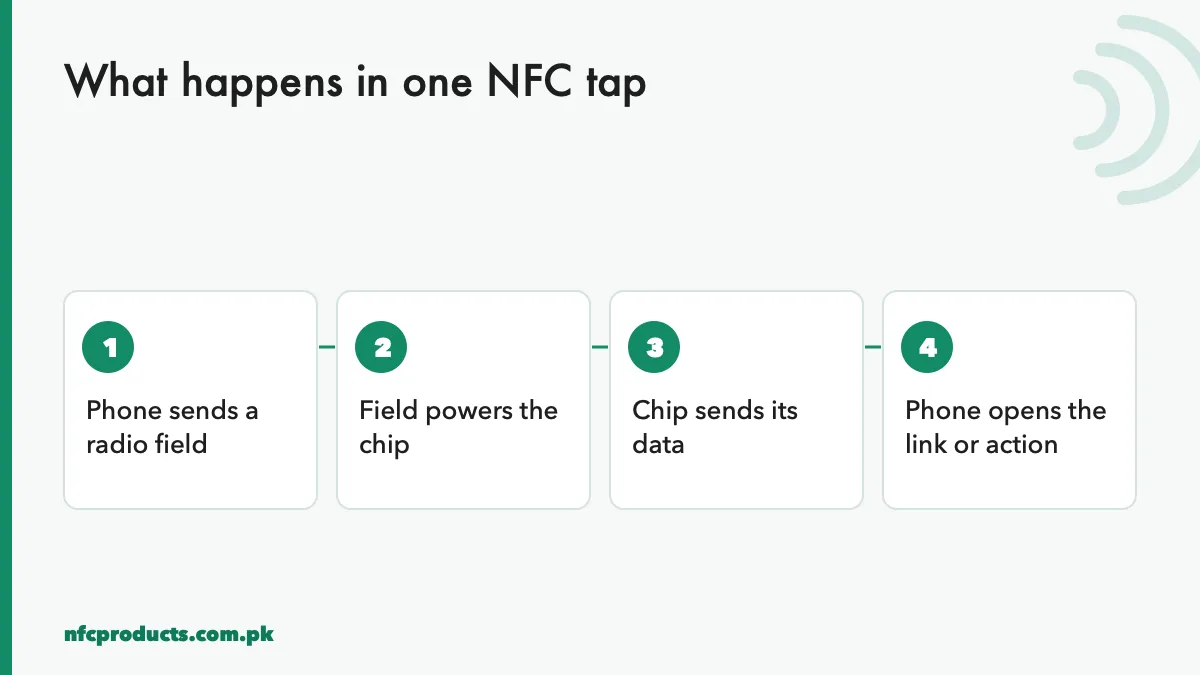
An NFC tap takes less than a second, but four things happen in order.
What happens in one NFC tap, from radio field to action.
The phone creates a radio field. When NFC is on, the phone’s antenna sends a weak radio signal at 13.56 MHz.
The field powers the chip. A passive NFC tag has no battery. Its coil antenna picks up energy from the phone’s field, which is enough to wake the chip.
The chip sends its data. The chip replies with what is stored in its memory, usually in a standard format called NDEF (NFC Data Exchange Format).
The phone acts on the data. If the tag holds a web link, the browser opens it. If it holds a contact, the phone offers to save it.
Because the tag is powered by the phone, an NFC tag can last for many years. The chips we sell, such as NXP’s NTAG213 and NTAG215, are rated by NXP for 10 years of data retention and 100,000 write cycles. Reading the chip does not wear it out.
Why the range is so short
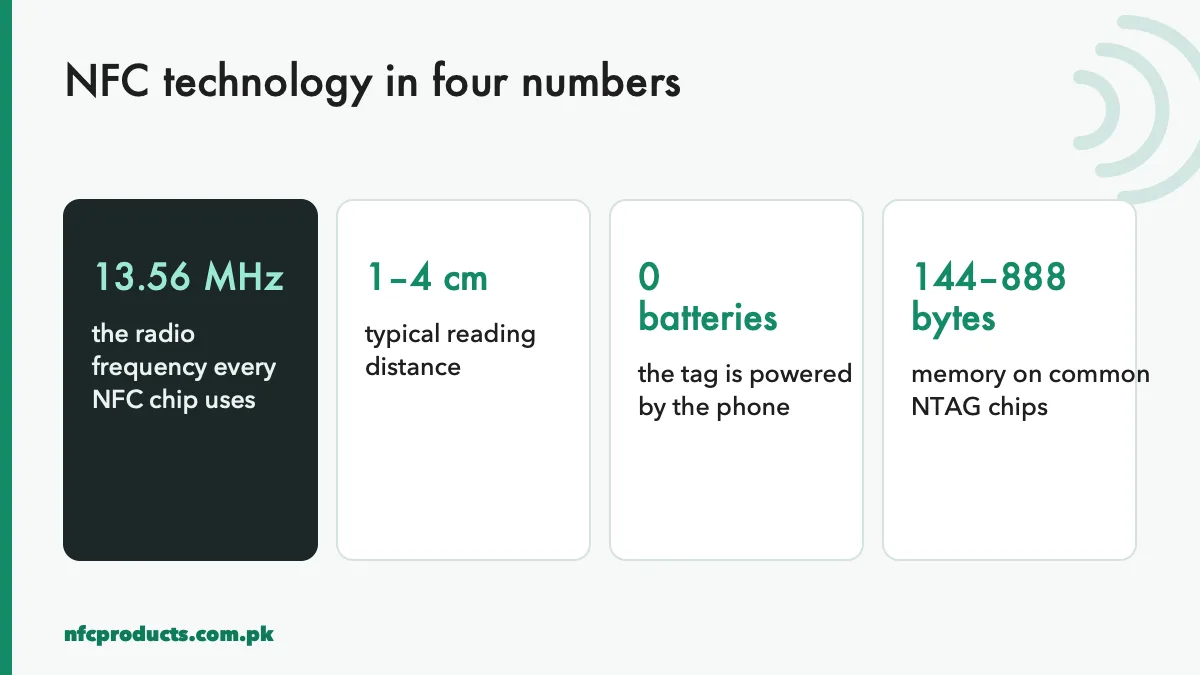
NFC is designed to work at 1 to 4 centimetres. That short range is deliberate. It means nothing happens by accident when you walk past a tag, and it makes the tap feel intentional, like pressing a button. It also limits eavesdropping, because a reader has to be almost touching the tag.
The four numbers that explain NFC technology.
The three modes of NFC technology
The NFC standard describes three ways two devices can talk. Knowing them helps you understand why the same phone can pay at a shop and read a business card.
Reader/writer mode
This is the mode behind almost every business use. The phone acts as a reader and the NFC tag is passive. The phone reads a link from a review stand, or, with an app such as NFC Tools, writes a new link to a blank card. When we encode cards for clients, we use this mode on a production phone or a USB writer.
Card emulation mode
Here the phone pretends to be a contactless card. This is how phone payments work in countries where banks support it: the terminal thinks it is reading a bank card, but it is reading a secure chip inside the phone. The same idea powers digital transit cards and some office access systems.
Peer-to-peer mode
Two phones exchange small amounts of data by touching back to back. Android Beam once used this to share contacts and photos, but most phones now use Bluetooth or Wi-Fi Direct for sharing, with NFC only used to start the connection. For businesses, peer-to-peer mode matters very little today.
A short history of NFC
NFC did not appear overnight. It grew from contactless smart cards, which were already used for transport tickets in cities like Hong Kong and Tokyo in the late 1990s. Engineers realised the same radio technique could let phones read and write small chips.
2002: Sony and Philips agree to develop a common near field standard.
2004: Nokia, Philips and Sony found the NFC Forum to publish open specifications.
2006: The first NFC Forum tag formats are published, so any compliant phone can read any compliant tag.
2010–2012: NFC reaches mainstream Android phones, and mobile payment trials begin.
2014 onwards: iPhones gain NFC for Apple Pay; from 2017 apps can read tags, and from 2018 newer iPhones read tags in the background.
Today the NFC Forum publishes the tag types, the NDEF data format and certification programmes. That is the reason a sticker bought in Islamabad works on a phone bought in Dubai: both follow the same public rules.
NFC tag, NFC card and NFC chip: what is the difference
People use these words loosely, so here is how they fit together.
Term
What it is
Example
NFC chip
The tiny integrated circuit that stores data
NXP NTAG215 with 504 bytes
NFC antenna
The coil that powers and connects the chip
Etched aluminium spiral in a sticker
NFC inlay
Chip and antenna on a thin film, not yet finished
Wet inlay for labels
NFC tag
Any finished item carrying a chip and antenna
Sticker, keychain, epoxy tag
NFC card
An NFC tag in credit-card size
PVC, wooden or hybrid metal card
So an NFC card is one type of NFC tag, and every NFC tag contains an NFC chip. When a buyer asks for “NFC”, the questions that matter are which chip, which shape, and which material.
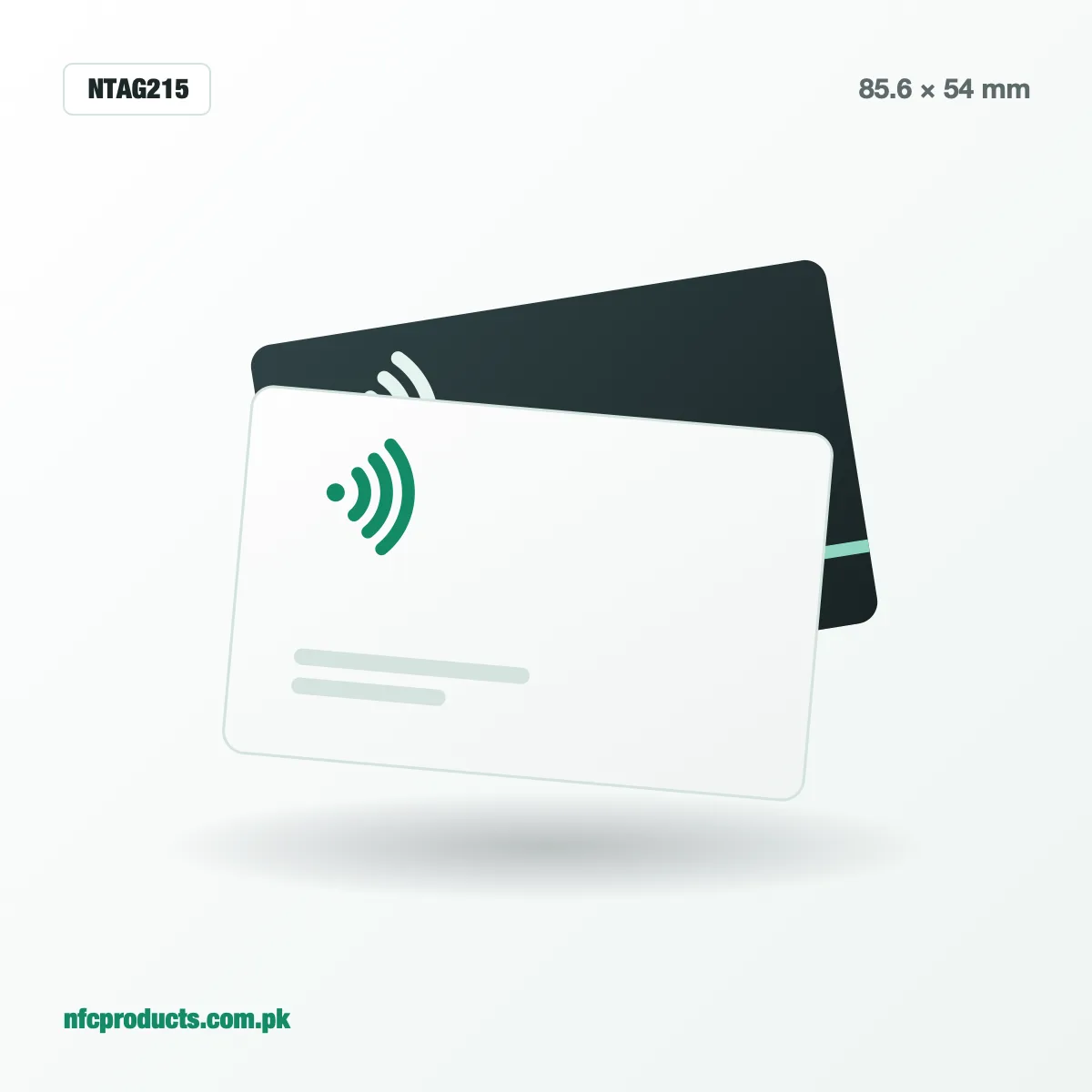
A CR80 PVC NFC card: the chip and antenna are sealed inside the plastic.
Where you already use NFC in Pakistan
You may be using NFC technology every week without calling it NFC. Here are nine easy examples.
Contactless bank cards. Many debit and credit cards issued in Pakistan carry the contactless wave symbol. Holding the card near the terminal uses NFC.
Digital business cards. A professional taps a card on a client’s phone and their profile, WhatsApp and website open, with no app to install.
Google review cards and standees. Restaurants, salons and clinics place a tap-to-review stand on the counter. One tap opens the Google review form.
Office and building access. Many access cards work on the same 13.56 MHz frequency family as NFC, and some modern systems accept NFC phones.
Restaurant menus. A tag on the table opens the digital menu, which is faster than scanning a printed QR code in poor light.
Wi-Fi sharing. A tag at reception can hold Wi-Fi details that Android phones can use to connect.
Product authentication. Brands add NFC labels to packaging so buyers can tap and confirm a product is genuine.
Events and gyms. Wristbands and keychains with NFC tags are used for check-in, membership and access.
Passports. Modern e-passports contain a chip that border systems read with NFC-type readers.
For businesses, the most common uses are the first three: business cards, review stands and menus. They are cheap, simple to set up, and customers understand them after one tap.
Which phones support NFC
Almost every iPhone from the iPhone 7 onwards has NFC, and iPhone XS and newer models read NFC tags in the background without opening an app. You simply hold the top edge of the phone near the tag.
On Android, NFC has been standard in most mid-range and premium phones for years, and it is spreading into budget models as well. The setting is usually under Connected devices or Connections. Some phones ship with NFC switched off, so if a tag does not respond, check the setting first. Our guides on NFC enabled phones in Pakistan and how to use NFC on iPhone walk through each step.
A quick test: open your phone’s settings and search for “NFC”. If the switch is there, your phone supports NFC technology.
Is NFC the same as Bluetooth or QR codes
No. All three move information from one device to another, but they work very differently.
Bluetooth connects two powered devices, such as a phone and earbuds, over several metres. It needs pairing and both sides need a battery.
QR codes are printed patterns that a camera reads. They cost nothing to print, but the phone has to open the camera, focus, and the code must be clean and well lit.
NFC needs a chip, but the tap is faster and works in the dark, through a sticker, and on a card that looks clean with no printed code.
Many businesses use both: an NFC tag for a quick tap and a QR code on the same card for the few phones without NFC. We compare them in detail in NFC vs QR code.
Is NFC safe to use
NFC is safe for everyday use. The short range makes it hard for anyone to read a tag from a distance, and a basic NFC tag only holds what you write on it, such as a link. It cannot install software on its own or take information from the phone.
Two sensible habits make it safer still:
Lock your tags after writing. A locked NTAG chip cannot be overwritten, so nobody can change your review link to a different page. See how to program and lock NFC tags.
Buy genuine chips. Clone chips can fail early or refuse to lock. You can check a chip with NXP’s free TagInfo app, as explained in our guide to genuine NXP NTAG chips.
For payments, banks add encryption and tokens on top of NFC, so a payment card tap is protected by more than the short range.
How businesses buy NFC tags and cards
If you plan to use NFC in your business or sell NFC products to clients, you will choose three things.
The chip. NTAG213 (144 bytes) is enough for one link. NTAG215 (504 bytes) fits a full contact card. NTAG216 (888 bytes) holds more still. Our NTAG213 vs NTAG215 vs NTAG216 guide explains the difference.
The form. Cards for people, stickers and inlays for packaging, anti-metal tags for machines, standees for counters, wristbands for events.
The grade. At NFC Products we sell every item in grades. Premium Grade uses a genuine NXP chip, every piece is tested, and it carries a 5-year replacement. Grade B uses a genuine NXP chip with a 1-year replacement. Grade C is the economy option for price-first jobs.
Wholesale prices start at Rs 50 per piece for NFC wet inlays, and blank PVC NFC cards start at Rs 75. You can see every line on our wholesale price list or browse the full range of wholesale NFC products.
Try NFC yourself in five minutes
The quickest way to understand NFC is to test it. You need a phone with NFC and one blank NFC tag or card.
Turn on NFC. On Android, open Settings and search for NFC. On iPhone XS and newer it is always on.
Install a writer app. NFC Tools by wakdev is free on Android and iPhone and is the app most printers use.
Write a link. In the app, choose Write, add a record, pick URL, and type your website or a Google review link.
Tap to write. Hold the blank tag against the back of the phone until the app confirms the write.
Tap to read. Close the app, lock and unlock your phone, then tap the tag again. Your link should open.
If the link opens on your phone and on a colleague’s phone of a different brand, the tag is working and correctly formatted. Our step-by-step guide on how to program NFC tags in bulk shows how printers encode hundreds of pieces a day.
Common myths about NFC
A few misunderstandings come up again and again when we speak to first-time buyers.
“NFC tags need an app.” They do not. iPhones and Android phones read standard NFC tags natively. You only need an app to write data to a blank tag.
“NFC drains the battery.” Keeping NFC switched on uses very little power. The phone only listens in short bursts.
“NFC works across the room.” It does not. If you need a range of several metres, you need UHF RFID, which is a different technology. We explain this in RFID vs NFC.
“All NFC cards are the same.” The chip, the antenna quality and the material decide whether a card still taps after two years in a wallet. That is why grade matters when you buy in bulk.
Frequently asked questions
What is the full form of NFC?
NFC stands for Near Field Communication. It is a short-range wireless technology that works at about 1 to 4 centimetres.
What is NFC used for on my phone?
Your phone uses NFC to read tags and cards, such as business cards, review stands and menus, and in many countries to make contactless payments.
Does an NFC tag need a battery?
No. A passive NFC tag is powered by the phone's radio field during the tap, so it has no battery to replace.
Can I use NFC without the internet?
Reading a tag works offline. But if the tag holds a web link, the phone needs mobile data or Wi-Fi to open the page.
Is NFC safe?
Yes, for everyday uses such as links and contact cards. The range is very short, and you can lock your tags so nobody can change what is stored on them.
Can NFC work through a phone cover?
Yes, through most plastic, silicone and leather covers. Thick covers with metal plates or magnetic rings can block the signal, so remove them if a tag will not read.
How much data can an NFC tag hold?
Common NTAG chips hold 144 to 888 bytes. That is enough for a web link, a Wi-Fi login or a short contact card, which is why most NFC tags store a link to a page rather than the page itself.
Send the product, grade and quantity on WhatsApp or the quote form. We reply within business hours (10am to 7pm) with a confirmed price and delivery date.