NFC is a type of RFID, but they are not the same. Here is how they differ in range, frequency, cost and security, and which one your project needs.
RFID vs NFC is one of the most common questions from buyers who are choosing tags for attendance, access control, inventory or marketing. The key fact: NFC is a specialised form of RFID. All NFC tags are RFID tags, but not all RFID tags are NFC. The difference lies in frequency, range and, most importantly, whether an ordinary smartphone can read them.
This guide explains RFID tags and NFC tags in plain language, lists eight easy differences with real examples, and ends with a simple rule for choosing. If you are planning a project in Pakistan, it will help you ask suppliers the right questions.
What is RFID
RFID stands for Radio-Frequency Identification. A reader sends out radio waves, and a tag with a chip and antenna answers with an ID or data. RFID has been used for decades in warehouses, toll plazas, libraries, animal tagging and building access.
RFID works on three main frequency bands:
Low frequency (LF), 125–134 kHz. Short range, slow data. Common in older access cards, key fobs and animal tags.
High frequency (HF), 13.56 MHz. Short range. Used in smart cards, library books and, crucially, NFC.
Ultra-high frequency (UHF), 860–960 MHz. Long range, several metres. Used for pallets, retail inventory and vehicle tags.
What is NFC
NFC stands for Near Field Communication. It is a subset of HF RFID at 13.56 MHz, standardised by the NFC Forum so that smartphones can read tags and talk to each other. NFC deliberately limits range to about 4 cm, and it defines a common data format, NDEF, so any NFC phone understands any NFC tag. For the basics, read what is NFC.
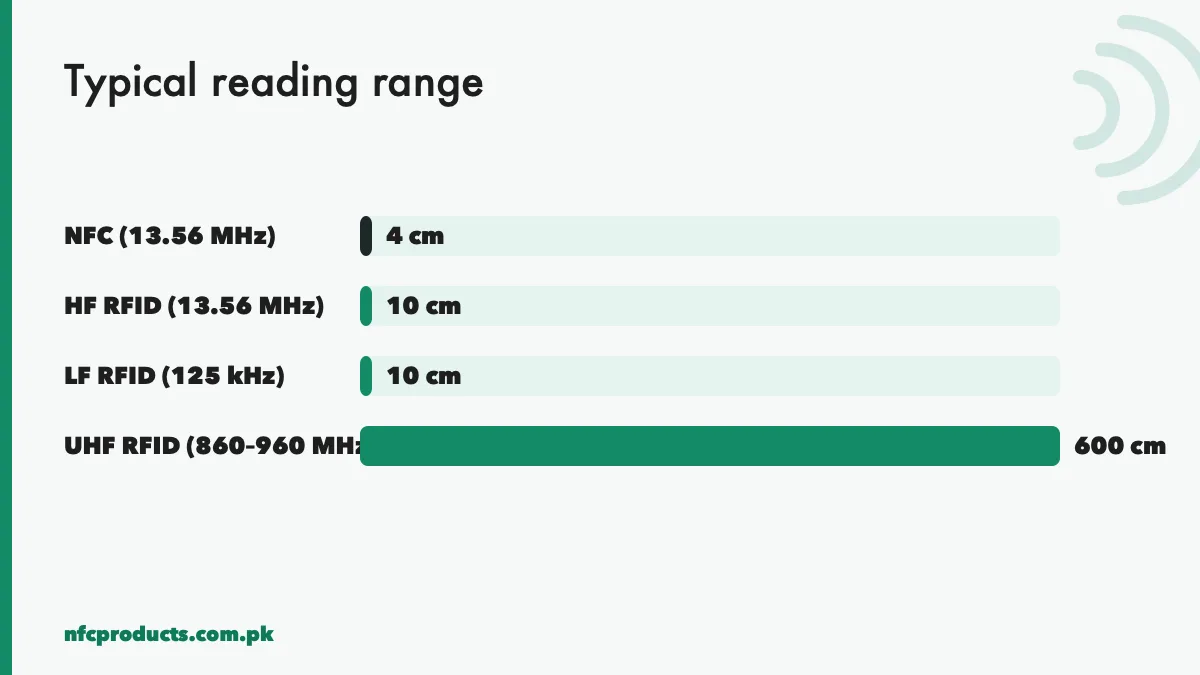
Typical reading ranges. Real range depends on the tag, reader and antenna.
RFID vs NFC: 8 differences
1. Frequency
NFC always uses 13.56 MHz. RFID can use 125 kHz, 13.56 MHz or 860–960 MHz. So an NFC phone can read some HF RFID tags, but never LF or UHF RFID tags.
2. Range
NFC works at 1 to 4 cm. LF and HF RFID usually work up to around 10 cm, and UHF RFID tags can be read from several metres. If you need to scan a pallet from across a room, NFC is the wrong tool.
3. Reader
NFC tags are read by any NFC smartphone, including iPhone XS and newer and most Android phones. RFID tags outside the NFC standard need a dedicated reader or gate. That makes NFC ideal for anything the public interacts with.
4. One tag or many
UHF RFID readers can read hundreds of tags at once, for example every item in a box passing through a gate. NFC is designed for one tag at a time, which is a benefit for customer interactions: nothing reads by accident.
5. Data format
NFC tags store data in the standard NDEF format, so a phone knows how to open a link or save a contact. Many RFID systems only store an ID number, and the meaning lives in the company’s own software.
6. Cost
Simple UHF RFID labels are very cheap in large volumes and are made for tracking goods. NFC tags cost a little more but include standard memory that a phone can read. At wholesale, our NTAG213 wet inlays start at Rs 50 per piece.
7. Security
Basic NFC tags such as NTAG213 are designed to share public data, with lock bits and optional password protection. Secure RFID and NFC chips, such as MIFARE DESFire, add encryption for access and payments. Security depends on the chip, not on whether it is called RFID or NFC. See NFC chip comparison.
8. Typical uses
RFID tags are used for supply chain, toll roads, libraries, livestock and high-volume inventory. NFC tags are used for business cards, review stands, menus, product authentication, event wristbands and phone payments.
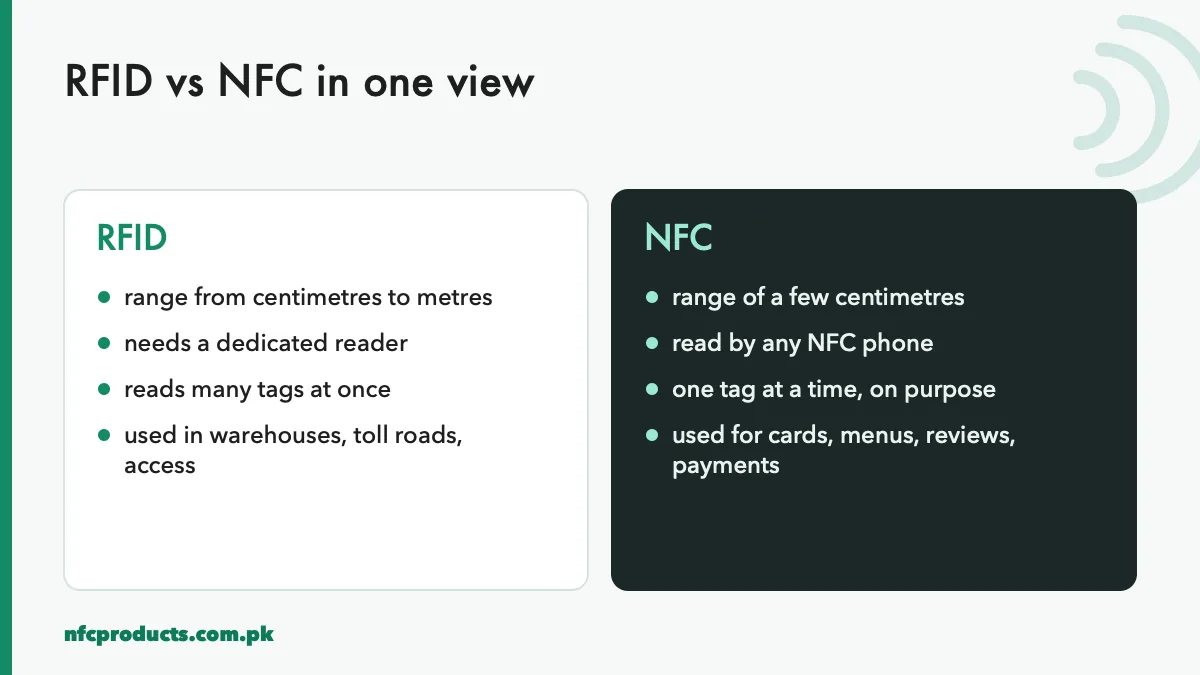
Where each technology fits.
RFID vs NFC comparison table
RFID
NFC
Frequency
125 kHz, 13.56 MHz or 860–960 MHz
13.56 MHz only
Range
Centimetres to metres
1–4 cm
Reader
Dedicated reader
Any NFC phone
Tags at once
Many (UHF)
One
Data format
Often just an ID
Standard NDEF records
Best for
Tracking goods and assets at scale
Interactions with people and phones
Real examples: which to choose
Office access cards
Many older buildings use 125 kHz RFID cards, which phones cannot read or emulate. Newer systems use 13.56 MHz cards, often MIFARE, and some accept phones. If a client asks for “NFC access cards”, find out which reader they have before quoting.
School or factory attendance
For attendance with a wall reader, both RFID cards and NFC cards can work, depending on the reader. If staff tap their own phones on a tag at the gate, you need NFC tags. Our guide to NFC tag uses for business explains both approaches.
Warehouse and inventory
To count stock on shelves or pallets without touching each item, UHF RFID is the right choice. To let a technician tap a machine and open its manual or service log, use NFC tags, and anti-metal NFC tags if the machine is metal.
Marketing, reviews and business cards
Anything a customer taps with a phone must be NFC: NFC business cards, review standees, menus and product labels. RFID tags outside the NFC standard simply will not open anything on a phone.
Events
For cashless payments and fast entry at large events, organisers use RFID or NFC wristbands with dedicated readers. For networking events where attendees tap each other’s phones, NFC wristbands with a link are simpler. See NFC wristbands for events.
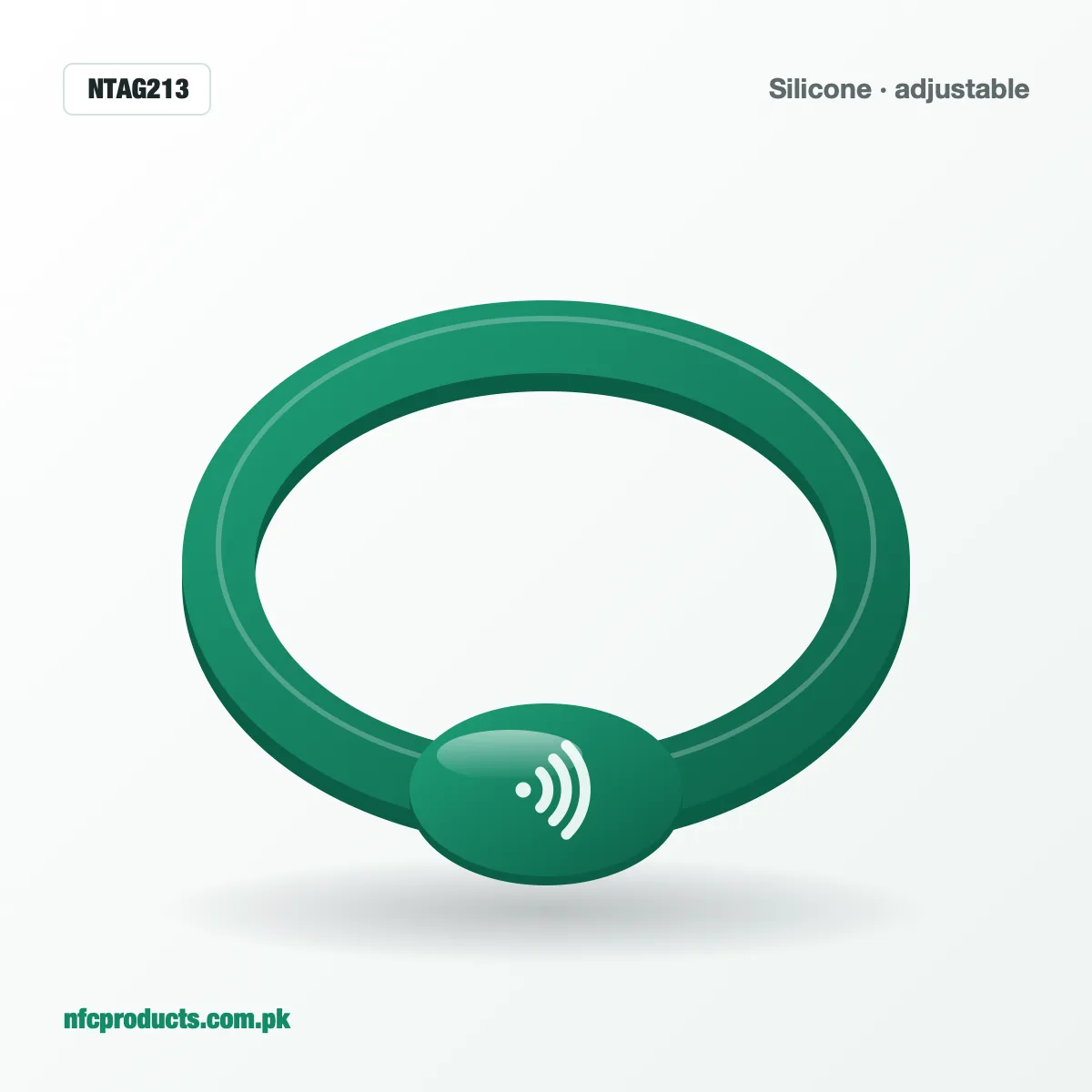
NFC wristbands work with phones and with event readers.
Can a phone read RFID tags
A phone can read RFID tags only if they are 13.56 MHz HF tags that follow a standard the phone understands, such as NFC Forum tags or some ISO 15693 tags on Android. Phones cannot read 125 kHz LF or UHF RFID tags at all. If a supplier sells “RFID stickers” for a phone project, check the frequency and chip type first.
Can NFC replace RFID
For interactions with people, yes, and NFC is usually better because every modern phone is a reader. For tracking thousands of items at a distance, no. The two technologies complement each other: many products carry a UHF RFID tag for the warehouse and an NFC tag for the customer.
How to choose between RFID and NFC
Ask three questions:
Who reads the tag? If it is a customer’s phone, choose NFC. If it is a fixed reader or gate, either can work.
How far away? A few centimetres: NFC or HF RFID. Metres: UHF RFID.
How many at once? One at a time: NFC. Many at once: UHF RFID.
If NFC is the answer, choose standard chips such as NTAG213 or NTAG215, which work with every NFC phone. Our NTAG213 vs NTAG215 vs NTAG216 guide helps you choose the chip, and our NFC tags range covers stickers, inlays, keychains, wristbands and anti-metal tags.
Common mistakes when buying RFID or NFC tags
Buying 125 kHz cards for a phone project. Phones cannot read them.
Using normal NFC stickers on metal. They will not read. Use anti-metal tags.
Expecting NFC to read from a distance. It is designed not to.
Assuming every 13.56 MHz card works with phones. Some chips need special apps. Standard NTAG chips do not.
How RFID tags and NFC tags are built
Both RFID tags and NFC tags have the same two basic parts: a chip and an antenna. The antenna design changes with the frequency.
LF RFID tags use a coil with many turns of copper wire, often wound around a small ferrite core in key fobs and animal tags.
HF RFID and NFC tags use a flat coil of a few turns, etched in aluminium or copper on a thin film. This is the inlay inside NFC cards and stickers.
UHF RFID tags use a dipole antenna, a long thin shape that looks nothing like a coil. It is tuned to radiate radio waves, which is why it reads from metres away.
You can often tell the type by looking at the inlay: a spiral coil means HF or NFC, a long zig-zag or bar shape means UHF. Our guide wet inlay vs dry inlay shows NFC inlays in detail.
Why NFC keeps its range so short
The short range of NFC is deliberate, not a weakness. It gives three benefits.
Intent. A tap is a deliberate action. Nothing happens when you walk past a tag.
Privacy. A reader must be almost touching the tag, which makes secret reading from a distance impractical.
Simplicity. One tag at a time means no confusion between neighbouring tags on a shelf or table.
For payments, business cards and menus, these benefits matter more than range. For counting pallets in a warehouse, they would be a problem, which is why UHF RFID exists.
Mixing RFID and NFC in one project
Many real projects use both. A few examples from the kinds of businesses we supply:
A garment brand puts a UHF RFID label inside each item for stock counts and an NFC label on the hang tag so customers can tap to check authenticity.
A school uses RFID cards with wall readers for gate attendance and NFC stickers in classrooms that open the timetable on a teacher’s phone.
A factory uses UHF RFID on pallets and anti-metal NFC tags on each machine so technicians can tap for the service history.
When you plan a project like this, choose each tag for its reader. Tags read by fixed readers can be RFID; tags read by people’s phones must be NFC.
Questions to ask an RFID or NFC supplier
Before ordering tags for any project, ask these questions. They prevent most expensive mistakes.
What frequency is the tag? 125 kHz, 13.56 MHz or UHF.
Which chip is inside? For phone projects, NTAG213 or NTAG215 are the safe choice.
Will it be placed on metal? If yes, you need anti-metal construction.
What reader will read it? A phone, a USB reader, a door reader or a gate.
Can you supply samples? Test samples with your actual reader or phones before buying thousands.
We supply NFC tags only, all at 13.56 MHz with standard NTAG chips, so they work with every NFC phone. For samples, use our bulk quote form.
Frequently asked questions
Is NFC the same as RFID?
NFC is a type of RFID that works at 13.56 MHz with a range of a few centimetres and a standard data format that phones understand.
Can my phone read RFID cards?
Only 13.56 MHz cards that the phone supports, such as NFC Forum tags. Phones cannot read 125 kHz or UHF RFID tags.
Which is cheaper, RFID or NFC?
Basic UHF RFID labels are cheaper in very large volumes. NFC tags cost a little more but work with any NFC phone. Our NFC inlays start at Rs 50 at wholesale.
Which has a longer range?
UHF RFID, up to several metres. NFC is limited to about 4 cm by design.
Can NFC be used for access control?
Yes, with the right chips and readers. Secure chips such as MIFARE DESFire are used for access; NTAG chips are better for sharing public information.
What are RFID tags used for in Pakistan?
Warehouse inventory, vehicle tags at toll plazas and access cards are common examples. NFC tags are used for business cards, review stands, menus and product labels.
Can a tag be both RFID and NFC?
Every NFC tag is technically an HF RFID tag. Some products also combine a separate UHF RFID tag and an NFC tag in one label.
Do RFID tags work on metal?
Standard tags of both kinds lose range or stop working on metal. Special on-metal versions use a spacer or ferrite layer, so they keep working when stuck on steel and aluminium surfaces such as machines, shelves and doors.
Send the product, grade and quantity on WhatsApp or the quote form. We reply within business hours (10am to 7pm) with a confirmed price and delivery date.