How Do NFC Cards Work? From Tap to Link in Six Steps
An NFC card has no battery, no screen and no Bluetooth, yet it opens a link in under a second. Here is exactly what happens inside the card and the phone.
How do NFC cards work if they have no battery and no power switch? The short answer: the phone does all the powering. When you hold an NFC card near a phone with NFC switched on, the phone’s radio field wakes the tiny NFC chip inside the card, the chip sends back what is stored in its memory, and the phone acts on it, usually by opening a link.
That whole exchange happens in a fraction of a second, over a distance of 1 to 4 centimetres. In this guide we follow a single tap step by step, look inside the card at the NFC chip and the NFC antenna, and explain why some cards read instantly while others need a second try. It is written for printers, resellers and business owners who want to understand the product they sell or buy.
The parts inside an NFC card
Before following the tap, it helps to know what is inside. Every NFC card, whether PVC, wood or hybrid metal, contains the same two working parts.
The NFC chip
The NFC chip is a small integrated circuit, smaller than a grain of rice, bonded to the antenna. It has memory to store data, logic to talk to the phone, and a unique serial number called the UID. Most business cards use NXP’s NTAG213 or NTAG215. The chip also holds lock bits, which can make the data permanent, and an optional password for write protection.
The NFC antenna
The NFC antenna is a flat coil of aluminium or copper that runs around the inside of the card. It has two jobs: to harvest energy from the phone’s field and to carry the signal back. The antenna’s size and shape affect how well the card reads. A larger antenna usually reads more easily, which is one reason card-size NFC tags are so forgiving compared with small 25 mm stickers.
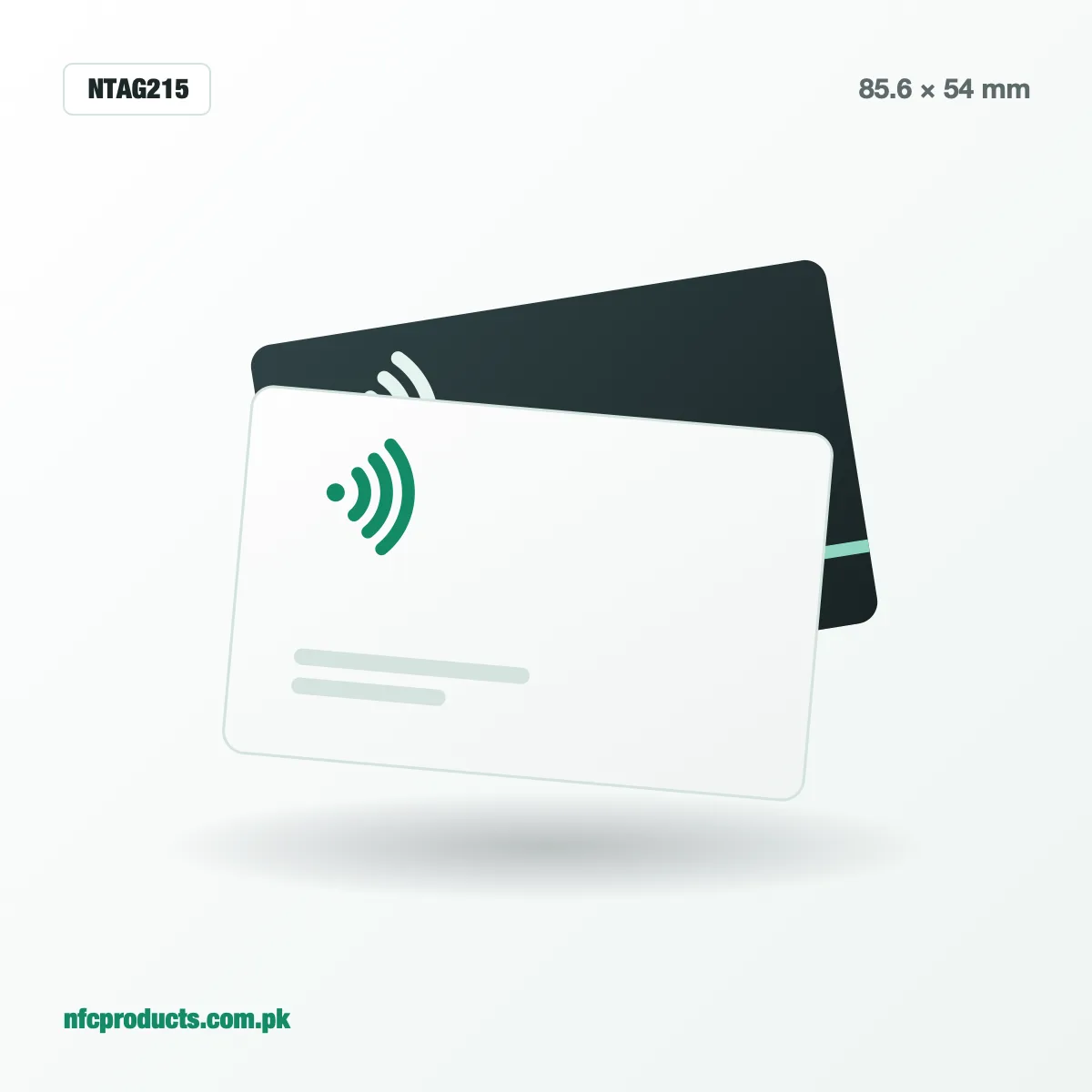
Together, the NFC chip and NFC antenna form an inlay. Card makers laminate the inlay between sheets of PVC, or set it into a pocket in wood or a metal frame. The finished card looks like any other card, which is why you cannot tell if a card has NFC just by looking.
The chip and antenna are laminated inside the PVC, invisible from outside.
How do NFC cards work: the tap in six steps
Here is what happens from the moment the card comes near the phone.
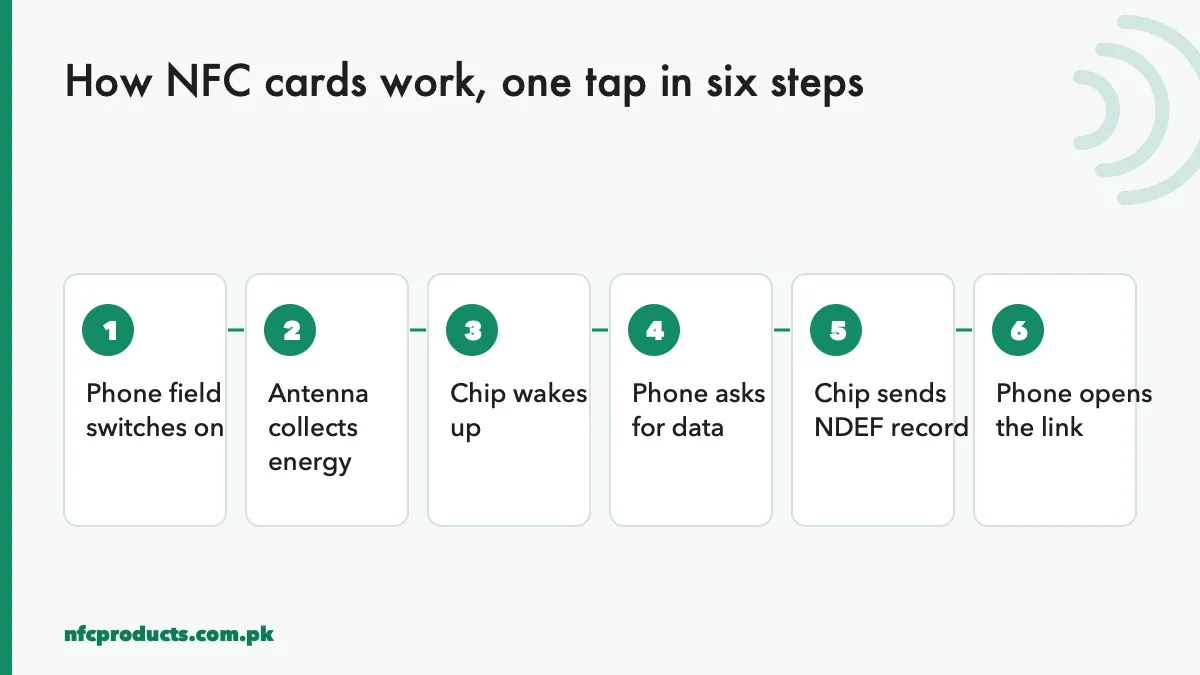
One tap, six steps, well under a second.
The phone’s field switches on. With NFC enabled, the phone’s own antenna regularly sends out a weak magnetic field at 13.56 MHz, listening for tags.
The antenna collects energy. When the card enters the field, the field induces a small current in the card’s NFC antenna. This is the same principle as a wireless charger, only much weaker.
The NFC chip wakes up. That current powers the chip for as long as the card stays in the field. Move the card away and the chip switches off again.
The phone asks for data. The phone identifies the chip type and reads its memory, following the ISO/IEC 14443 protocol that all NTAG chips use.
The chip sends an NDEF record. Data on the card is usually stored in NDEF (NFC Data Exchange Format), a standard wrapper that tells the phone “this is a link” or “this is a contact”.
The phone opens the link. The phone’s operating system reads the record type and acts: it opens the browser, offers to save a contact, or starts an app.
On iPhone XS and newer, and on Android, steps 1 to 6 happen in the background without any app. The user sees a notification or the page opens directly.
Why the card needs no battery
The card borrows power from the phone for the duration of the tap. This is called passive NFC. It is why a card can sit in a drawer for years and still work the first time you tap it, and why NFC cards never need charging. The trade-off is range: because the card relies on the phone’s weak field, it only works a few centimetres away.
What is stored on the NFC chip
The NFC chip’s memory is divided into small blocks called pages. Some pages hold the chip’s UID and configuration, and the rest is user memory for your data.
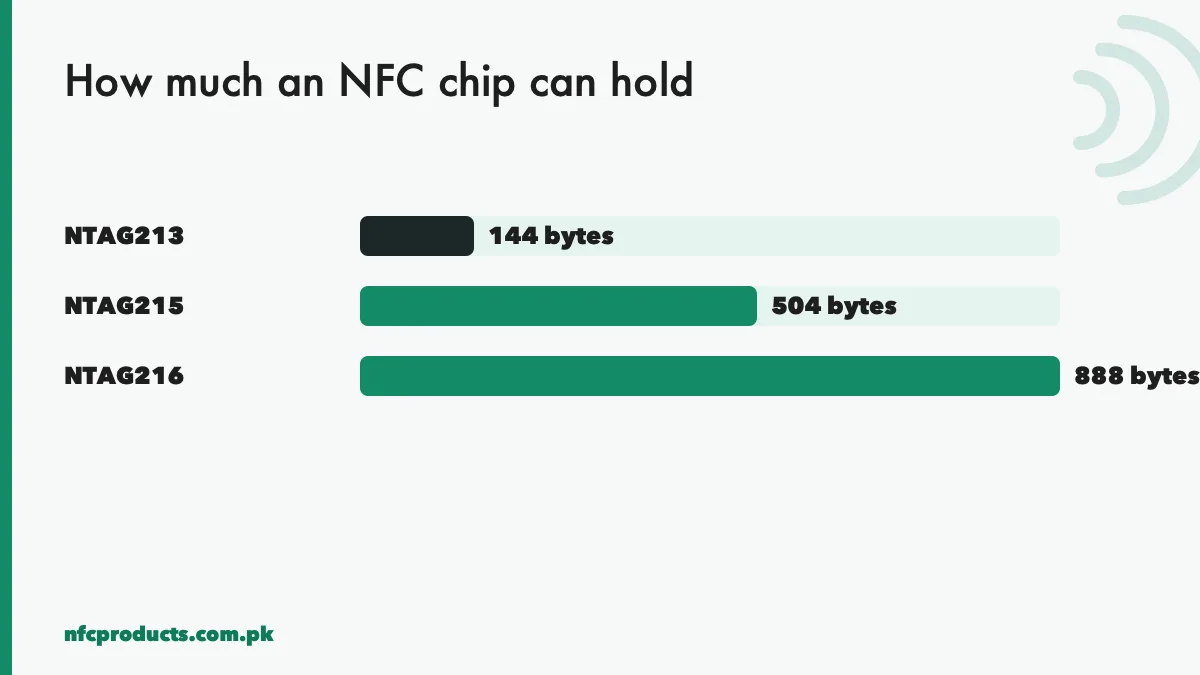
User memory on the three NTAG chips.
NFC chip
User memory
What fits
NTAG213
144 bytes
One link of about 130 characters
NTAG215
504 bytes
A long link or a full vCard
NTAG216
888 bytes
A detailed vCard or several records
For most uses, a link is all you need. A profile page can hold far more than any NFC chip, and it can be updated without touching the card. That is why digital business card platforms write a short link, not the whole profile, to the chip. Our NTAG213 vs NTAG215 vs NTAG216 shows real examples of what fits on each chip.
The UID and why it matters
Every genuine NXP chip has a 7-byte unique ID set at the factory. Some systems use the UID to identify a card, for example attendance or loyalty systems. The UID is read-only on genuine chips. Some clone chips allow the UID to be changed, which is one reason businesses that rely on UIDs should buy genuine NXP NTAG chips.
Why some NFC cards read better than others
If you have tested cards from different suppliers, you will have noticed that some read instantly and some need you to move the phone around. Several things cause the difference.
Antenna quality. A well-tuned NFC antenna matched to the chip reads from further away. Cheap inlays sometimes have poorly etched antennas.
Chip quality. Genuine NXP chips are consistent. Clone chips vary from batch to batch.
Material thickness. Very thick card bodies, or metal layers close to the antenna, weaken the signal.
Where the phone’s antenna is. On iPhones it is near the top edge. On most Android phones it is in the middle of the back, sometimes near the camera. Tapping the wrong spot is the most common reason a good card seems not to work.
Phone cases. Cases with metal plates, magnetic rings or card wallets with other chips can block or confuse the reading.
This is where grades matter in wholesale. Our Premium Grade cards are read and write tested one by one before dispatch, so every card in the box has proven it works. See the wholesale price list for what each grade includes.
How NFC cards are written and locked
A blank NFC card has empty user memory. Writing, also called encoding, puts your link or contact onto the NFC chip. You need a phone with an NFC writing app, such as NFC Tools, or a USB NFC writer connected to a computer.
Choose the record type, usually URL.
Type or paste the link.
Hold the card to the phone or writer to write it.
Test the card on two different phones.
Lock the card, so the data becomes permanent.
Locking sets the chip’s lock bits. After that, the data can be read but never changed, which protects your client’s link from being overwritten. It cannot be undone, so always test first. Our guide to programming and locking NFC tags in bulk covers each step in detail.
Printers who encode hundreds of cards should always test a sample from every batch on both an iPhone and an Android phone before locking.
How metal NFC cards work
Solid metal reflects and absorbs the phone’s magnetic field, so an NFC antenna placed directly on metal will not work. Metal NFC cards solve this with a hybrid construction: the chip and NFC antenna sit in a non-metal area or behind a ferrite layer that shields them from the metal. When done well, a hybrid metal card reads almost as easily as PVC. When done badly, it only reads at one exact spot. Read do metal NFC cards work before buying metal cards from any supplier, and see our hybrid metal NFC cards.
The same principle is behind anti-metal NFC tags, which use a ferrite layer so they can be stuck directly on machines and metal shelves.
NFC cards compared with bank cards and access cards
People often ask whether an NFC business card works like a contactless bank card. Both use 13.56 MHz and the same basic radio technique, but the chips are very different.
Bank cards use secure chips that perform encryption for every payment. The chip proves it is genuine without revealing the card’s secrets.
Access cards in offices often use MIFARE chips, which add security features such as keys and sectors.
NFC business cards use NTAG chips, designed to share public information like a link as easily as possible.
That is why an NFC business card is simple and cheap, while a bank card is far more complex. For a comparison of chip families, read NFC chip comparison.
The standards that make NFC cards work everywhere
An NFC card bought in Islamabad works on a phone bought anywhere in the world because both follow the same public standards. The radio layer follows ISO/IEC 14443, and the data format follows the NFC Forum’s NDEF specification. The NFC Forum certifies devices and publishes these specifications, and chip makers such as NXP build chips that follow them.
For buyers, the practical rule is simple: choose cards with a standard NFC Forum Type 2 chip such as NTAG213 or NTAG215, and they will work with every NFC phone.
How the phone decides what to open
After the NFC chip sends its data, the phone has to decide what to do with it. It looks at the record type inside the NDEF message.
URI record: a web address, phone number, email or WhatsApp link. The phone opens the right app: browser, dialler, mail or WhatsApp.
Text record: plain text. Many phones show it but do nothing else, which is why a card with a text record can seem “dead”.
MIME record: data with a type, such as a vCard (text/vcard) or Wi-Fi settings. Android handles these well; iPhones are more selective.
Android Application Record (AAR): tells an Android phone to open a specific app. Useful for custom apps, ignored by iPhones.
For products used by the public, a URI record is the safe choice because every NFC phone opens it the same way. If you are writing cards for a client and they report that “nothing happens”, check the record type first.
Security features inside an NFC chip
NTAG chips are designed for sharing public information, but they still have security features that matter for business use.
Lock bits. Setting them makes the memory read-only for ever. This stops anyone rewriting your review link or menu link.
32-bit password protection. The chip can require a password before writing. This keeps the card editable by you but not by strangers.
Originality signature. Genuine NXP chips carry a signature that apps such as NXP TagInfo can verify. It proves the chip is genuine.
Unique ID. The 7-byte UID is fixed at the factory on genuine chips.
None of these make an NTAG chip suitable for payments or high-security access control. For those, systems use secure chips such as MIFARE DESFire. But for business cards, stands and labels, lock bits and genuine chips are exactly what you need.
How printers test a batch of NFC cards
If you produce NFC cards for clients, testing protects your reputation. A simple routine works for batches of any size.
Check the chip on arrival. Read a few cards with NXP TagInfo to confirm the chip type and originality.
Write and verify. When encoding, use software that reads each card back after writing, so a failed write is caught at once.
Test on two platforms. Tap sample cards on an iPhone and an Android phone, because they handle records differently.
Lock only after testing. A locked card with a typo in the link cannot be fixed.
Keep a record. Note which link went on which card, especially for staff cards with individual profiles.
Our Premium Grade cards arrive already read and write tested, so step 1 becomes a spot check rather than a full inspection. For encoding hundreds of cards, see how to program NFC tags in bulk.
Frequently asked questions
How do NFC cards work without a battery?
The phone's radio field induces a small current in the card's antenna, which powers the chip during the tap. The card has no battery and never needs charging.
How close does the phone need to be?
Usually 1 to 4 cm. Place the phone's NFC area, the top edge on iPhone or the centre of the back on most Android phones, on the card.
Can an NFC card be read through a wallet?
Often yes, through leather or fabric. But other NFC or RFID cards in the same wallet can interfere, so tap the card on its own for best results.
Does an NFC card send data on its own?
No. It only responds when a phone's field powers it. It cannot broadcast or track anyone.
Why does my NFC card open nothing?
It may be blank, locked with an old link, or the phone's NFC may be off. Check the card with an NFC reading app to see what is stored.
How long does the NFC chip last?
NXP rates NTAG chips for 10 years of data retention and 100,000 write cycles. Physical damage is the usual cause of failure, not the chip wearing out.
Send the product, grade and quantity on WhatsApp or the quote form. We reply within business hours (10am to 7pm) with a confirmed price and delivery date.