NFC tags and QR codes both open a link on a phone. Here is how they really compare on speed, cost, reliability and security, and why many businesses use both.
NFC vs QR code is a question almost every business owner asks before buying review stands, menus or digital business cards. Both do the same basic job: they get a customer’s phone to open a link. But they do it in very different ways, and the difference shows up in speed, cost, reliability, design and security.
This guide gives you nine honest differences, with no sales talk, and a simple rule for choosing. The short version: a QR code is almost free and works on every camera phone, while an NFC tag is faster, cleaner and more reliable in real conditions. For customer-facing products in Pakistan, many businesses use both on the same item.
How NFC and QR codes work
A QR code is a printed square pattern that stores a link or text. The phone’s camera reads the pattern, decodes it, and shows the link. It was invented by Denso Wave in 1994 for tracking car parts, and you can read its history on the official QR code website.
An NFC tag is a small chip with an antenna, hidden inside a card, sticker or stand. When a phone with NFC comes within a few centimetres, it powers the chip by radio and reads the link. No camera, no light and no aiming are needed. Our guide how do NFC cards work explains the tap in detail.
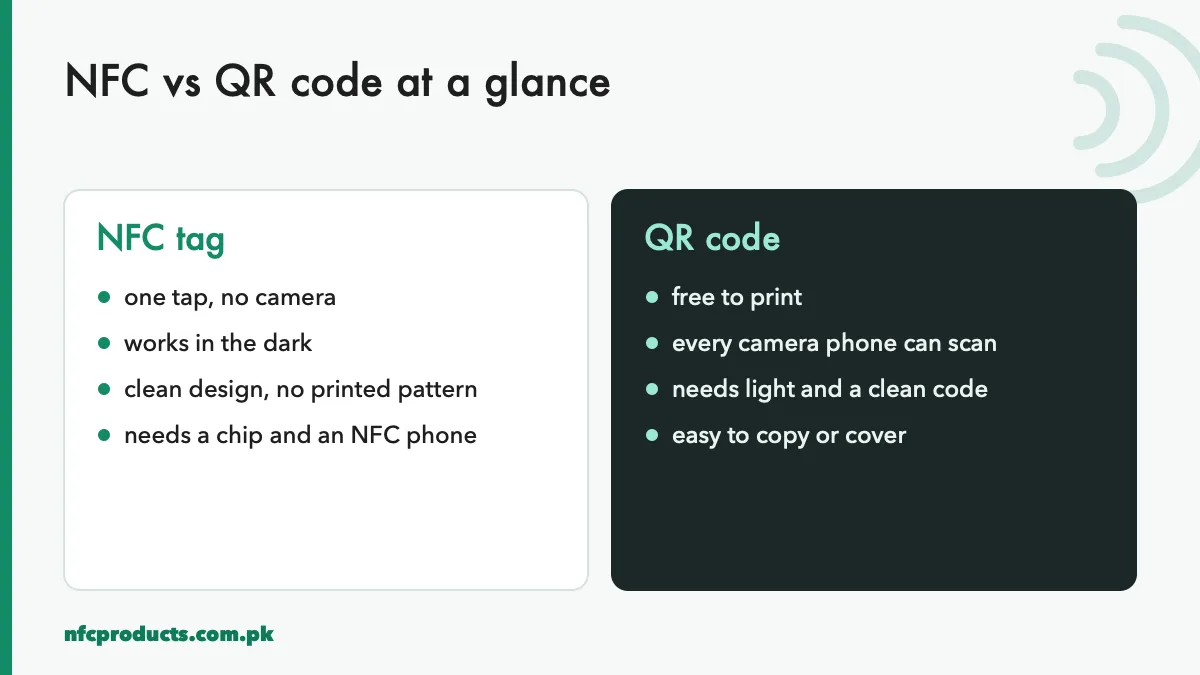
The two technologies side by side.
NFC vs QR code: 9 differences
1. Speed
With NFC, the customer taps and the link appears, usually in under a second. With a QR code, the customer opens the camera or a scanner, aims, waits for focus, then taps the link. In our tests at counters, NFC is typically two to four seconds faster. That sounds small, but at a busy restaurant counter it decides whether the customer bothers at all.
2. Phone support
Every smartphone with a camera can scan a QR code; most recent phones do it straight from the camera app. NFC needs an NFC phone. All iPhones from the XS onwards read tags automatically, and most mid-range and premium Android phones have NFC, but some budget phones do not. This is the QR code’s biggest advantage.
3. Lighting and condition
A QR code needs light and a clean, flat, undamaged print. Dim restaurants, glare on laminated menus, scratches and folds all cause failed scans. An NFC tag works in the dark, through a sticker, and when the surface is scratched, because it does not rely on the image.
4. Cost
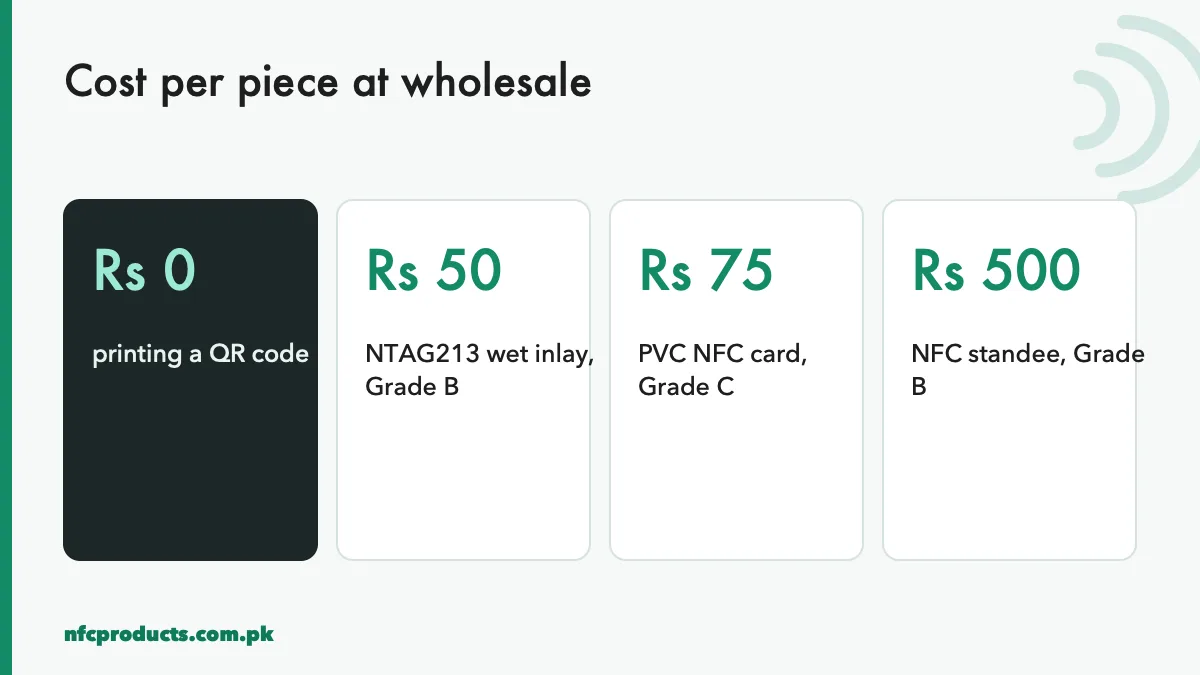
Printing a QR code costs nothing extra. An NFC tag costs from Rs 50 per piece at wholesale for a wet inlay, and a finished NFC standee costs more. For thousands of flyers, QR wins on cost. For a counter stand used thousands of times, the NFC tag’s cost is tiny per use.
What each option costs per piece.
5. Design
A QR code is a large black-and-white pattern that you have to fit into the design. An NFC tag is invisible, so a card or stand can look clean and premium, with just a small tap icon. Designers of premium wooden and metal NFC cards often prefer NFC for this reason.
6. Changing the link
Both can point to a link you control, so both can be updated by changing the page behind the link. A plain QR code with a fixed link cannot be changed after printing. An unlocked NFC tag can be rewritten; a locked one cannot. For most business use, point both to a page you control.
7. Security
QR codes are easy to copy and easy to cover with a fake sticker, a known trick in public places where a bad actor pastes a new code over the real one. An NFC tag can be locked so its link cannot be changed, and it is hidden inside the product, so tampering is harder. Neither is a security device on its own, but NFC is harder to swap. See genuine NXP chips.
8. Durability
A printed QR code fades, scratches and peels. An NFC chip inside PVC or epoxy keeps working for years; NXP rates its NTAG chips for 10 years of data retention. For stands and labels outdoors or in kitchens, a protected NFC tag outlasts a printed code.
9. Customer familiarity
After years of QR menus and payments, most Pakistani customers know QR codes. Fewer know NFC, so NFC products need a simple “Tap your phone here” instruction. Once customers try NFC, they usually prefer it for its speed.
Comparison table
Factor
NFC tag
QR code
Speed
One tap
Open camera, aim, tap
Phone support
NFC phones
Every camera phone
Needs light
No
Yes
Cost per piece
From Rs 50
Free to print
Design
Invisible chip
Visible pattern
Tamper resistance
Lockable, hidden
Easy to cover or copy
Durability
Years inside PVC or epoxy
Fades and scratches
Offline reading
Yes
Yes
When to use an NFC tag
Choose NFC when speed, design or reliability matter more than cost per piece:
Google review stands at restaurant, salon and clinic counters, where customers are standing and busy. See NFC standees.
Digital business cards for people who want a premium impression. See blank NFC cards.
Product authentication, where a lockable, hidden tag is harder to fake than a printed code. See genuine NXP chips.
When to use a QR code
Choose a QR code when reach and cost matter most:
Flyers, posters and newspaper ads printed in thousands.
Audiences with many older or budget phones, some without NFC.
Payment QR codes, which are already standard in Pakistan’s banking apps.
Why many businesses use both
The most practical answer to NFC vs QR code is often “both”. Print a small QR code on the same card or stand that carries the NFC tag. Customers with NFC tap; the rest scan. Both open the same link, so you track one page.
This is what we recommend to clients ordering review standees and business cards: NFC as the main experience, QR as the backup. It costs nothing extra to print, and no customer is left out.
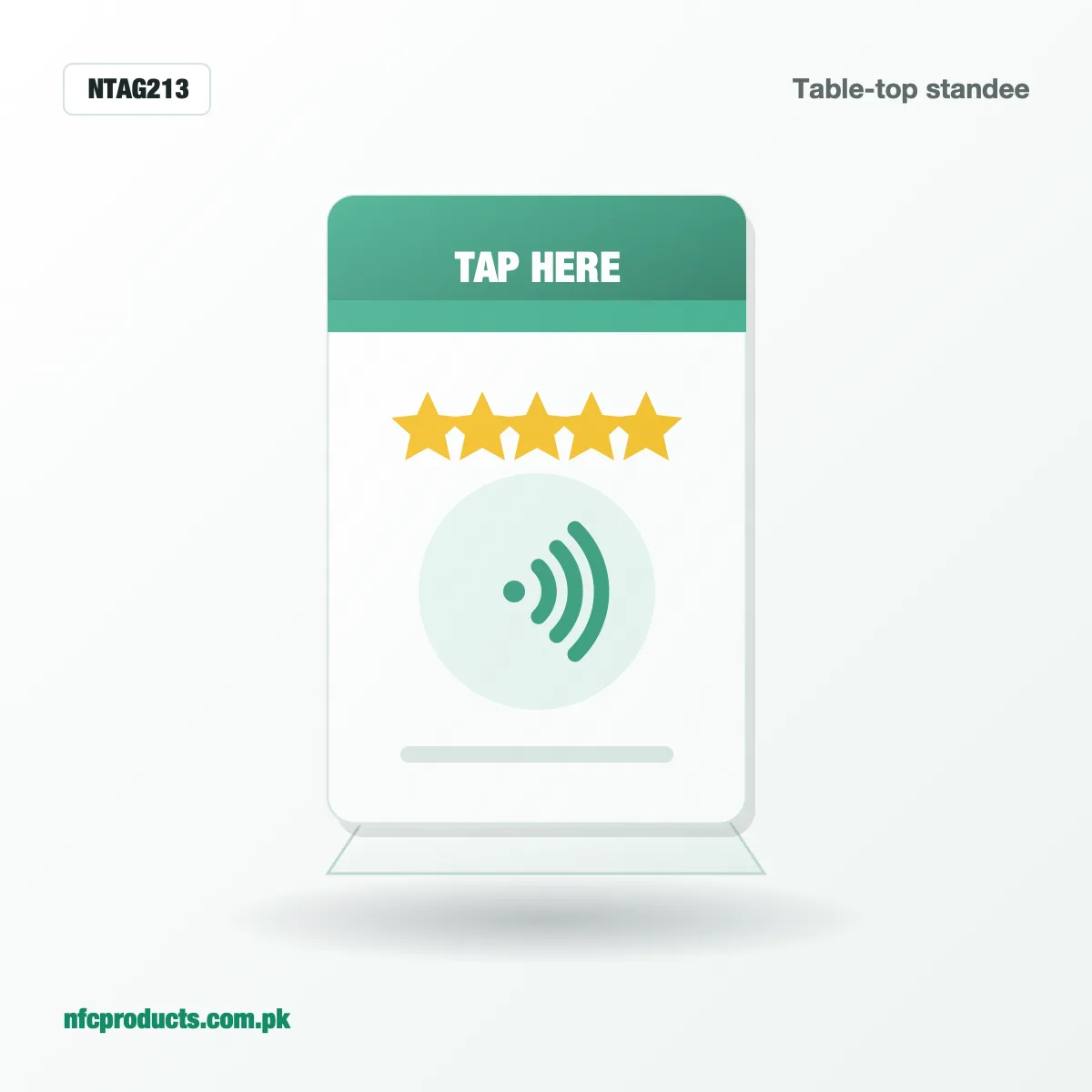
A review standee can carry an NFC tag and a printed QR code together.
How to set up NFC and QR together
Create one link, such as your Google review link or profile page.
Generate a QR code for that link with any free generator. Test it with two phones.
Write the same link to the NFC tag with the NFC Tools app, as a URL record. See how to program NFC tags.
Print clear instructions: “Tap or scan to review us”.
If you order printed products from us, send the link and we can encode the NFC tags and print the QR code on the same job. See custom printing and encoding.
Common myths in the NFC vs QR code debate
“NFC is expensive.” At wholesale, an NFC tag starts from Rs 50 per piece. For a stand used daily for years, that is negligible.
“QR codes are more secure.” They are easier to copy and to cover with a fake. Security depends on the page behind the link, not the code.
“NFC only works on Android.” Every iPhone from the XS onwards reads NFC tags automatically.
“Customers do not understand NFC.” A short “Tap your phone here” note solves this in most cases.
NFC vs QR code by industry
The right choice depends on where the customer is standing and what phone they carry. Here is how we see it across the businesses we supply in Pakistan.
Restaurants and cafes
Restaurants used printed menus with codes widely after 2020, and customers know how to scan them. The weak points are dim lighting, laminated menus with glare, and table cards that get stained. An NFC sticker under the table card fixes the lighting problem. The best setup is a table card with a tap area and a small printed code below it. See NFC tag uses for business.
Salons, clinics and retail counters
At a counter, the customer is standing, often holding a bag or a child. Asking them to open the camera and aim loses many reviews. A tap on an NFC review standee takes one second. Businesses that switch from a printed code to an NFC stand usually see more customers actually leave a review, because the effort is lower. See get more Google reviews.
Business cards
A code on a paper visiting card works, but it looks busy and the recipient has to scan it later. An NFC business card opens the profile during the meeting, when the person still remembers you. For premium clients, NFC cards also look cleaner, especially in wood and metal.
Packaging and product labels
Codes on boxes are cheap and familiar, but they are easy to copy onto fake products. NFC labels hidden inside packaging, especially with genuine NXP chips that carry an originality signature, are harder to fake. Brands that fight counterfeits increasingly add NFC. See NFC stickers and inlays.
Outdoor signs and posters
Posters are read from a distance, often by people walking past. A large printed code can be scanned from a metre away; NFC needs the person to walk up and touch the poster. For outdoor posters, a big code is usually better, with an NFC tag as a bonus for people who come close.
What customers in Pakistan prefer
Habits are changing. Payment codes in banking apps have made scanning familiar to millions of people. At the same time, more customers carry iPhones and mid-range Android phones with NFC, and once they tap an NFC card for the first time, most prefer it. In our experience, the deciding factor is instruction: a stand that says “Tap your phone here” gets tapped; a plain stand gets ignored.
That is why good design matters more than the technology itself. Whichever you choose, tell customers what to do in one short line, place the tag or code where their hand naturally goes, and test with both an iPhone and an Android phone before you put it out.
Measuring results from NFC and QR codes
If you want to know which one your customers use more, give each its own link. For example, point the NFC tag to your review page with one tracking parameter and the printed code to the same page with another. Your website analytics will then show how many visits came from each. After a month you will know whether your customers prefer to tap or scan, and you can adjust your products.
Frequently asked questions
Is NFC better than a QR code?
NFC is faster, cleaner and more reliable in poor light, but needs an NFC phone and costs more per piece. A QR code works on every camera phone and is free to print. Many businesses use both.
Do NFC and QR codes work offline?
Reading works offline for both. Opening a web link needs mobile data or Wi-Fi.
Can an NFC tag and a QR code point to the same link?
Yes. That is the recommended setup: one link, two ways to open it.
Which is safer, NFC or QR code?
A locked NFC tag hidden inside a product is harder to tamper with than a printed QR code, which can be covered by a fake sticker. Always point both to a page you control.
Do iPhones read NFC tags like QR codes?
Yes. iPhone XS and newer read NFC tags automatically when the screen is on, similar to scanning a QR code with the camera but without aiming.
What does an NFC review stand cost compared with a QR stand?
At wholesale, our NFC standees start at Rs 500 per piece in Grade B. A QR-only stand costs only the printing. The NFC version is faster for customers and lasts longer.
Can I add a QR code to my NFC business cards?
Yes. Print it on the back, pointing to the same profile link. Phones without NFC can then scan it.
Send the product, grade and quantity on WhatsApp or the quote form. We reply within business hours (10am to 7pm) with a confirmed price and delivery date.