An NFC card is a normal-looking card with a chip and antenna inside. Here is how it works, what it is made of, what it costs and how to choose one.
What is an NFC card? An NFC card is a card, usually the size of a bank card, with a small NFC chip and a coil antenna sealed inside. When someone holds a phone near it, the phone powers the chip and reads what is stored on it, most often a link to a digital profile, a website, a Google review page or a contact card.
From the outside, an NFC card looks like any printed card. The difference is the tap. Instead of handing over paper that ends up in a drawer, you tap your NFC card on a client’s phone and your details open on their screen, ready to save.
This guide answers the eight questions we hear most from printers, agencies and business owners in Pakistan before their first order: what is inside the card, how the NFC business card works, which chip and material to choose, how much it costs, and how long it lasts.
What is an NFC card made of
Every NFC card has three layers working together.
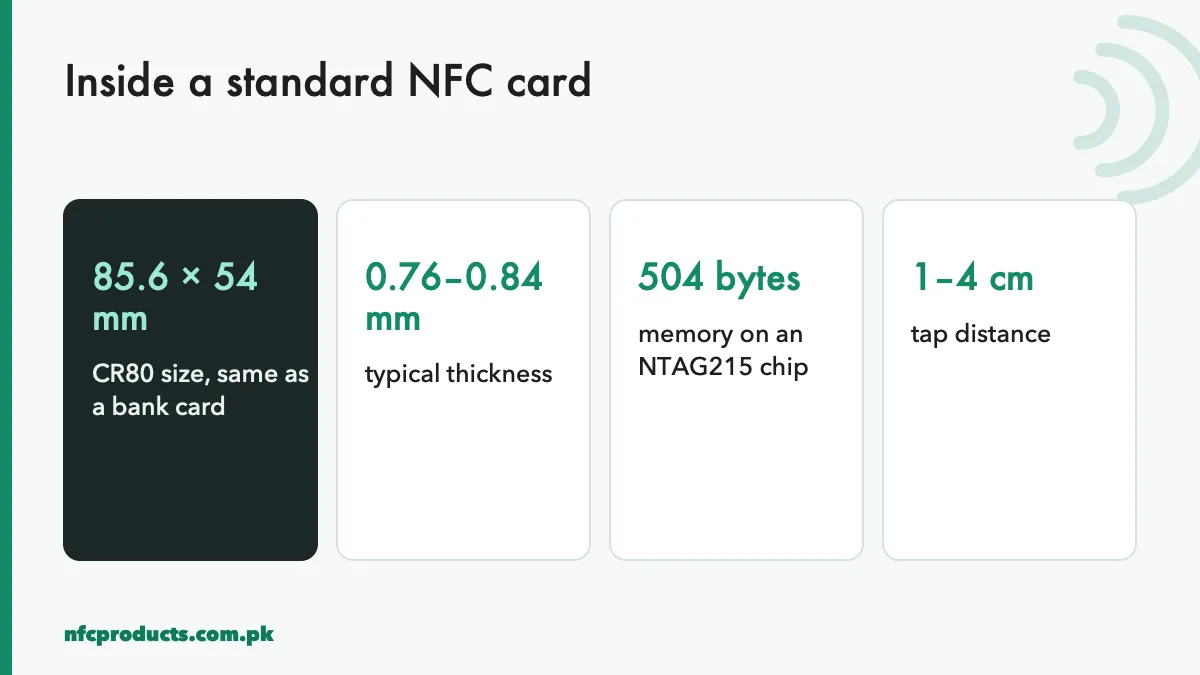
The chip. A tiny integrated circuit that stores data. Most NFC business cards use NXP’s NTAG215, with 504 bytes of user memory, or the NTAG213, with 144 bytes.
The antenna. A coil of etched aluminium or copper wire around the edge of the card. It collects energy from the phone and carries the signal.
The body. The material around the chip and antenna: PVC plastic, wood, or a hybrid of metal and plastic. This is what people see and feel.
The chip and antenna are usually supplied as an inlay, a thin sheet that card makers laminate between layers of PVC or embed in wood. Our wet inlay vs dry inlay guide explains the inlay types in more detail.
The numbers that define a standard NFC card.
The standard NFC card size
Most NFC cards follow the CR80 size from ISO/IEC 7810 ID-1: 85.6 × 54 mm with rounded corners, the same as a bank card or national ID card. That size fits wallets and card holders, and card printers are built for it. You can read the standard summary on the ISO website, and our guide to PVC NFC cards covers thickness and bleed for printing.
How does an NFC business card work
An NFC business card works in four steps, all in under a second.
The client’s phone, with NFC switched on, sends out a weak radio field at 13.56 MHz.
The card’s antenna catches that field, which wakes the chip. The card has no battery.
The chip sends back the data stored on it, usually a web link in the NDEF format that every phone understands.
The phone shows a notification or opens the link: your profile, WhatsApp, website or vCard.
Because the card only carries a link, you can change what it opens later by editing the page, without reprinting the card. That is why most NFC business card platforms store a link to a profile rather than the full contact details on the chip. For a deeper look at the process, read how do NFC cards work.
An NFC card does not need an app to be read. iPhone XS and newer, and Android phones with NFC switched on, read it on their own.
Which chip should an NFC card have
The chip decides how much the card can store and how reliably it reads. For most buyers the choice is between two NXP chips.
Chip
User memory
Best for
Typical use
NTAG213
144 bytes
One short link
Review cards, menu cards
NTAG215
504 bytes
A long link or a full vCard
NFC business cards
NTAG216
888 bytes
Larger records
Rare for business cards
For an NFC business card, NTAG215 is the safe standard: it holds a profile link with room to spare, or a complete contact card written directly to the chip. That is why all our blank NFC cards use NTAG215. Our NTAG213 vs NTAG215 vs NTAG216 guide compares them in detail.
Genuine or clone chips
Not every “NTAG215” is made by NXP. Clone chips can behave well on day one and fail months later, or refuse to lock. You can check a card with NXP’s free TagInfo app, which reads the chip’s originality signature. Our guide to genuine NXP NTAG chips shows exactly what to look for.
PVC, wooden or metal: which NFC card material
The material changes the look, the price and how the card can be personalised. It does not change what the phone reads.
Choose the material by the client, not by the chip.
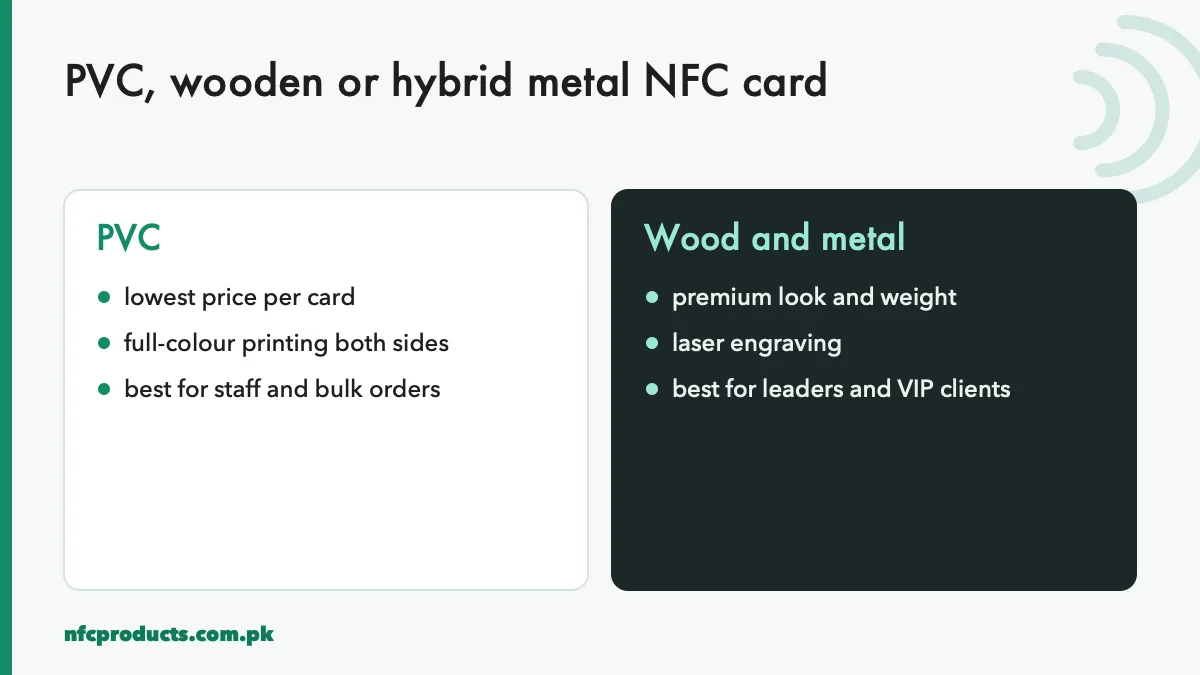
PVC NFC card. The most common and lowest-cost option. It takes full-colour printing on both sides and suits staff cards, bulk client orders and promotional work. Blank PVC NFC cards start at Rs 75 per card in Grade C.
Wooden NFC card. Warm, eco-friendly look, usually laser engraved with a logo and name. Popular with architects, designers and brands with a natural image. From Rs 600 per card.
Hybrid metal NFC card. Heavy and premium, laser engraved. Solid metal blocks NFC, so these cards use a hybrid build that places the chip where the phone can reach it. From Rs 1,200 per card. Read do metal NFC cards work before buying metal from any supplier.
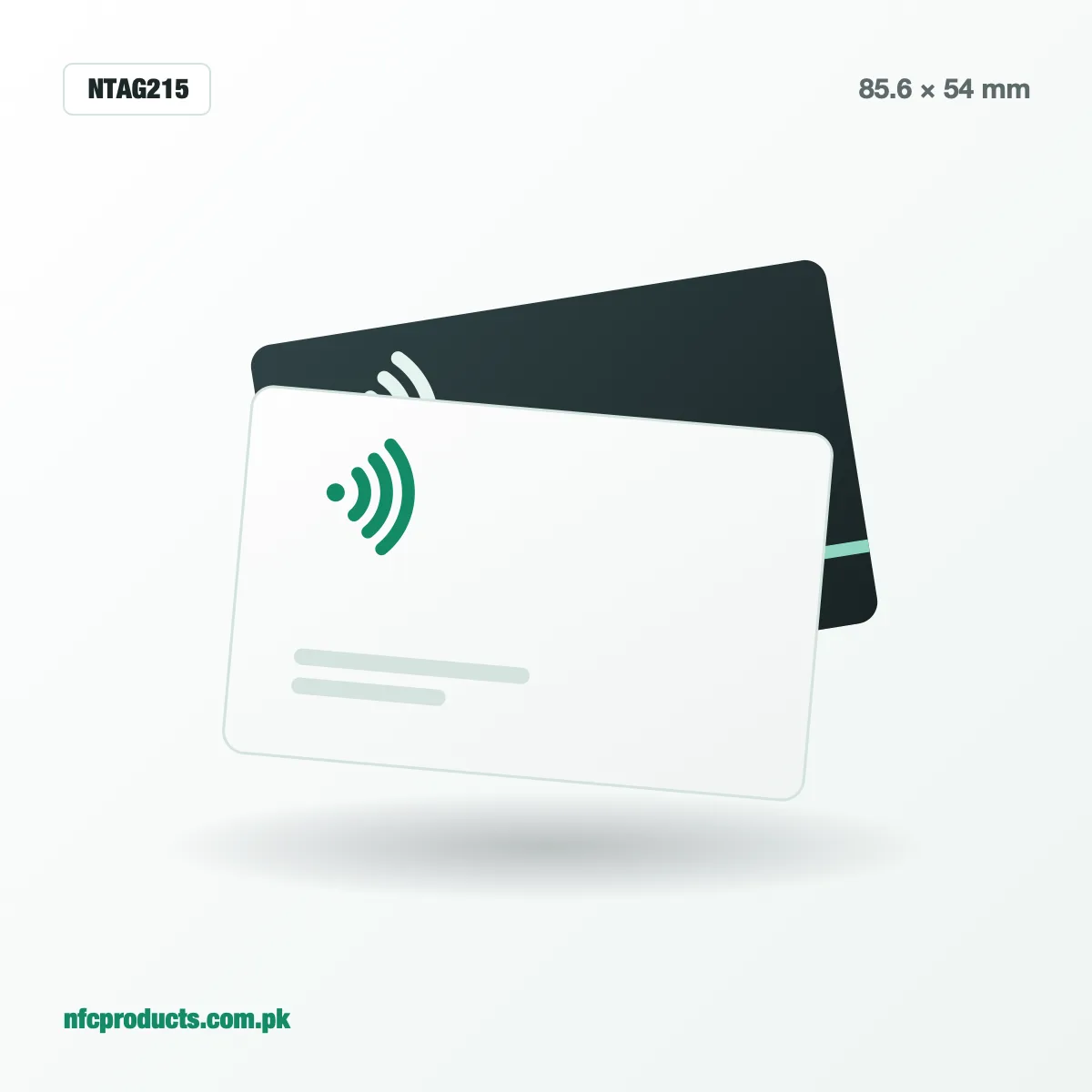
A blank white PVC NFC card, ready for printing and encoding.
What can you store on an NFC card
An NFC card can store any standard NFC record. The most useful ones for business are:
A web link to a digital profile, website, portfolio, catalogue or booking page.
A WhatsApp link in the form wa.me/92XXXXXXXXXX, which opens a chat with your number. See NFC tag uses for business.
A contact card (vCard) with name, phone, email and company, saved straight to the phone. See our NTAG213 vs NTAG215 guide.
A Google review link that opens the review form for a business.
Wi-Fi details that Android phones can use to join a network.
Most businesses choose a link, because a link can point to a page that is updated at any time. A vCard on the chip is fixed until someone rewrites the card.
How much does an NFC card cost in Pakistan
Prices depend on the material, the chip grade and the quantity. For blank wholesale stock without a profile portal, these are our per-card prices at the minimum order:
NFC card
Premium Grade
Grade B
Grade C
PVC NFC card (NTAG215)
Rs 999
Rs 500
Rs 75
Wooden NFC card (NTAG215)
Rs 1,499
Rs 750
Rs 600
Hybrid metal NFC card (NTAG215)
Rs 1,999
Rs 1,499
Rs 1,200
The grade explains the gap. Premium Grade uses a genuine NXP chip and thick premium material, every card is read and write tested, encoding is free, and any card that stops tapping within 5 years is replaced. Grade B uses a genuine NXP chip with standard material and a 1-year replacement. Grade C uses an NTAG-compatible chip and economy material for price-first jobs. See the full wholesale price list.
The minimum order is 50 cards for Premium Grade, 100 for Grade B and 150 for Grade C. Custom printing, engraving and encoding are quoted per order.
How long does an NFC card last
The chip itself is rated by NXP for 10 years of data retention and 100,000 write cycles. Reading does not wear it. In practice, an NFC card fails for physical reasons: it is bent sharply, cracked, or the antenna is damaged by a hole punch or a heavy crease.
To make NFC cards last:
Choose thicker material for cards that live in wallets. That is one reason Premium Grade uses thick premium PVC.
Avoid punching holes near the chip, which usually sits in one corner or the centre. Ask your supplier where the chip is before adding a lanyard slot.
A paper visiting card costs a few rupees and is thrown away in days. An NFC card costs more but is kept, used again and updated without reprinting. In Pakistan, where many professionals change numbers or roles, the ability to edit the profile behind the card is a real saving.
Many people now carry both: an NFC card for important meetings and clients, and paper for mass handouts. Some printers add a QR code to the back of the NFC card, so phones without NFC can still open the same link. We compare the two technologies in NFC vs QR code.
Who buys NFC cards in bulk
NFC Products is a wholesale supplier, so most of our NFC cards go to businesses that personalise and sell them:
Digital business card companies that sell a profile platform and need reliable blank cards.
Agencies and corporate gift suppliers that produce branded cards for staff and clients.
Companies that issue NFC cards to their sales teams.
If you are starting out, our guide on starting an NFC business card business explains the costs, the platforms and how to price your cards.
How to print and encode an NFC card
A blank NFC card becomes a finished product in two separate jobs: printing the surface and writing the chip. They can be done by the same printer or by two different people.
Printing the card
White PVC NFC cards go through the same PVC card printers used for ID cards, such as dye-sublimation retransfer machines. UV flatbed printers are also common for short runs. Wooden and metal NFC cards are usually laser engraved rather than printed. A few rules keep the chip safe:
Test one card first. Printers differ, and a quick test shows whether the heat or pressure affects the card.
Keep printing within the safe area. Leave about 3 mm bleed and keep text away from the edges.
Avoid heavy foil over the chip area unless your supplier confirms it will not block the signal.
Our full guide on how to print on NFC cards covers printer types, temperatures and a checklist for your first batch.
Encoding the chip
Encoding means writing the link or contact to the chip. For a few cards, a phone with the free NFC Tools app is enough. For hundreds, printers use a USB NFC writer and a spreadsheet of links, so each card gets the right profile. The steps are the same either way: write, test on two phones, then lock. See how to program NFC tags in bulk.
At NFC Products, Premium Grade orders include free encoding and locking. For Grade B, encoding is quoted per order, and Grade C is supplied blank.
How to choose an NFC card supplier
The cheapest quote is not always the lowest cost. A batch of NFC cards that stops tapping after six months costs you reprints, refunds and your client’s trust. Before you order in bulk, ask any supplier these questions:
Which chip is inside, and is it genuine NXP? Ask for a sample and check it with NXP TagInfo yourself.
Is every card tested? Premium work should be read and write tested one by one.
What is the replacement policy? A written replacement period shows the supplier trusts the stock.
Where is the chip placed? You need this before designing, punching or foiling.
Do you hold stock in Pakistan? Stock in the country means delivery in days, not weeks.
Can you print and encode, or only supply blank? One supplier for both saves time on repeat orders.
We answer these on our about page and wholesale FAQ. Samples can be arranged before any bulk order.
Common problems with NFC cards and simple fixes
Most complaints about NFC cards have simple causes.
The card does not open anything. NFC may be switched off on the phone, or the card may be blank. Check with NFC Tools that data is written.
Works on Android but not on iPhone. The link may be written as plain text instead of a URL record, or the iPhone is older than the XS. Rewrite it as a URL.
Stopped working after some months. Usually physical damage or a clone chip. Genuine chips in thick material last far longer.
Opens the wrong page. The card was not locked, or the profile link changed. Lock cards after testing.
Our troubleshooting guide, NFC card not working, goes through each case step by step.
Frequently asked questions
What is an NFC card in simple words?
It is a card with a small chip and antenna inside. When you tap it on a phone, the phone reads the chip and opens a link, contact or other action.
Does an NFC card need a battery or charging?
No. The phone powers the chip during the tap, so the card never needs charging.
Can an NFC card work on iPhone?
Yes. iPhone XS and newer read NFC cards without an app. Older iPhones from the iPhone 7 onwards can read them through the Control Centre NFC reader or an app.
Can I reuse an NFC card for another person?
Yes, if the card has not been locked. You can rewrite it with a new link using an app such as NFC Tools. Once locked, it cannot be changed.
What is the difference between an NFC card and an NFC business card?
An NFC card is any card with an NFC chip. An NFC business card is an NFC card programmed to share a person's contact details or profile.
Is an NFC card safe to carry?
Yes. It only holds what you write on it, usually a link, and it only works at a few centimetres. Lock the card after writing so nobody can change its link.
Can NFC cards be printed on both sides?
Yes. White PVC NFC cards take full-colour printing on the front and back. Keep heavy metallic foil away from the chip area and test one card before printing a full batch.
What is the minimum order for NFC cards?
At NFC Products the minimum is 50 cards for Premium Grade, 100 for Grade B and 150 for Grade C, per product. You can mix PVC, wooden and metal NFC cards in one order.
Do NFC business card platforms work with any card?
Yes, if the card uses a standard NFC Forum chip such as NTAG215. The platform gives you a profile link, and you write that link to the card with an app or ask the supplier to encode it.
How fast is delivery for NFC cards in Pakistan?
Blank stock ships from Islamabad by Leopards: prepaid orders arrive in 1–3 working days and cash on delivery orders in 3–5 days, with delivery charges paid separately.
Send the product, grade and quantity on WhatsApp or the quote form. We reply within business hours (10am to 7pm) with a confirmed price and delivery date.